Qovaryx 3.0 ships a local strategy engine, scoped specialist models, four public risk profiles, and optional BYO-AI chat that lets you plug in a hosted provider or local model. Core signal and risk decisions run on your laptop's CPU. Here is the full feature list, product tour, and sourced comparison.
General-purpose LLMs can be useful research assistants, but their fluent answers are not a substitute for an execution policy. In Qovaryx, BYO-AI handles user-requested analysis and chat. It cannot submit orders. The order path stays with deterministic strategy code, bounded specialist inputs, broker capability checks, and universal risk controls. Different job. Different tool.
Small task-specific models cover regime, pattern, volatility, direction, breakout, and forecast context. Each model has a bounded role: scoped execution authority, shadow evaluation, forecast context, or offline research. Hosted chat models are not on the order path.
Options-income, earnings-drift, breakout, overnight gap-fade, tactical allocation, volatility-crush, and tail-risk configurations share one capability-aware dispatch and risk layer. Strategies that fail their required gates abstain.
Where a model is validated for a consumer, its probability or rank is calibrated and scoped to that use. No single confidence number is presented as certainty, and unavailable features trigger abstention rather than invented precision.
Dedicated head detects market volatility states (RISK_ON / RISK_OFF / VOL_CRUSH / CHOP) and auto-demotes BUY signals in risk-off conditions.
Scheduled earnings and high-impact events can block incompatible entries. PEAD-specific consumers use their own post-event rules rather than bypassing the shared calendar silently.
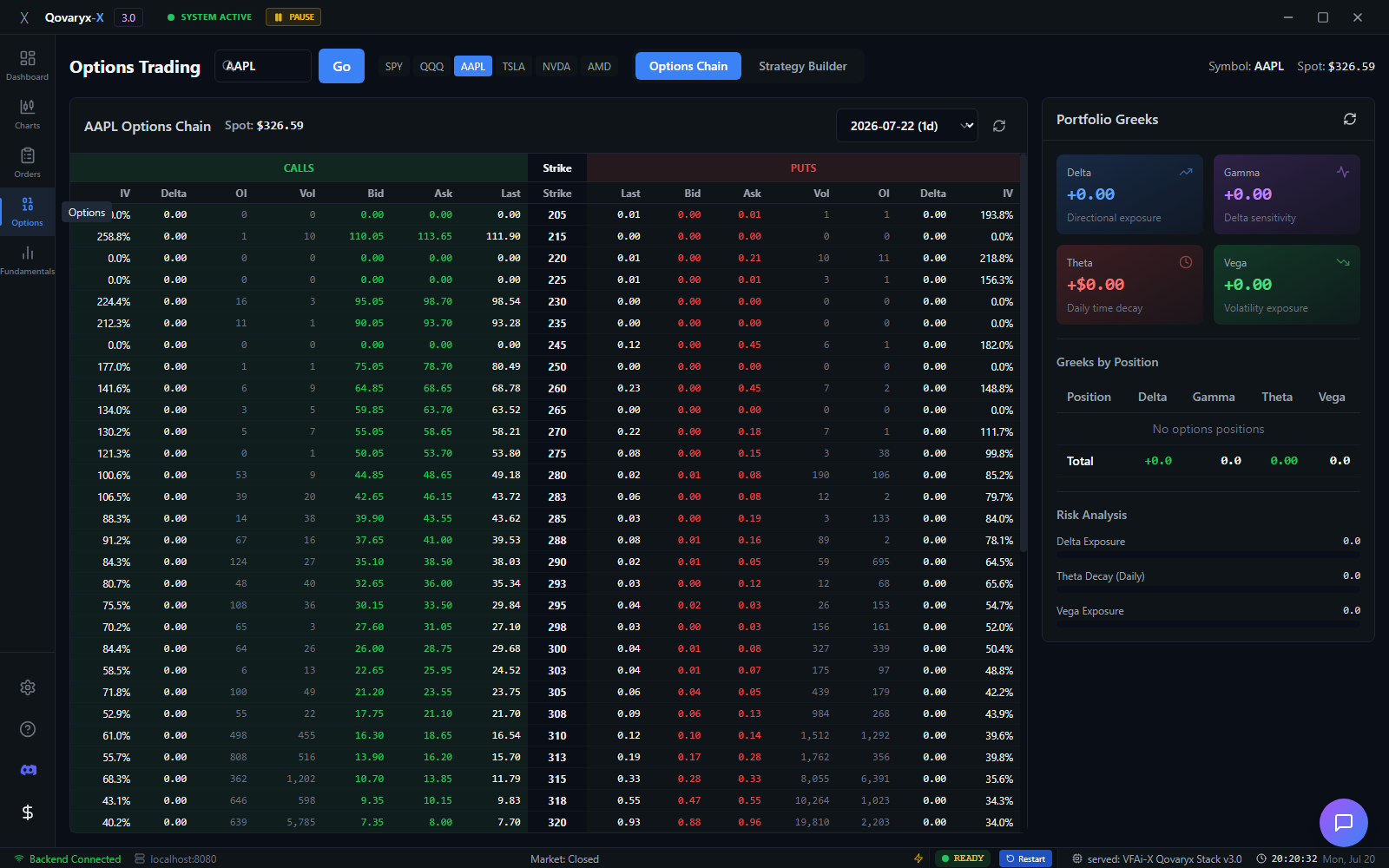
Greeks, implied volatility, liquidity, spread, open interest, and contract affordability are evaluated before an eligible options order can be constructed.
Feature coverage, regime, event, flow, broker-capability, and consumer-specific vetoes can all return NO_TRADE. A missing or contradictory signal is not converted into a guess.
Conservative, Standard, Aggressive, and Extreme tune position and concurrency limits. Aggressive and Extreme require explicit acknowledgement; higher profiles retain mandatory profit-reserve behavior and account-aware capacity controls.
Every profile retains daily-loss halts, concentration limits, drawdown acknowledgement, fill-quality monitoring, and realistic execution haircuts. Higher risk tolerance never disables the shared safety layer.
Earnings blackout (±1 day, non-PEAD strategies) + event-impact blackout (HIGH/CRITICAL non-PEAD) + options-flow disagreement gate + VIX regime priority + head-voted-no-trade veto + PDT governor. Qovaryx refuses setups the brutal test shows lose money. "Cluster sees no edge. Sit out."
The cluster refuses to score if <40% of trained feature columns are supplied. Emits NO_TRADE with a list of missing features so you can see why it abstained.
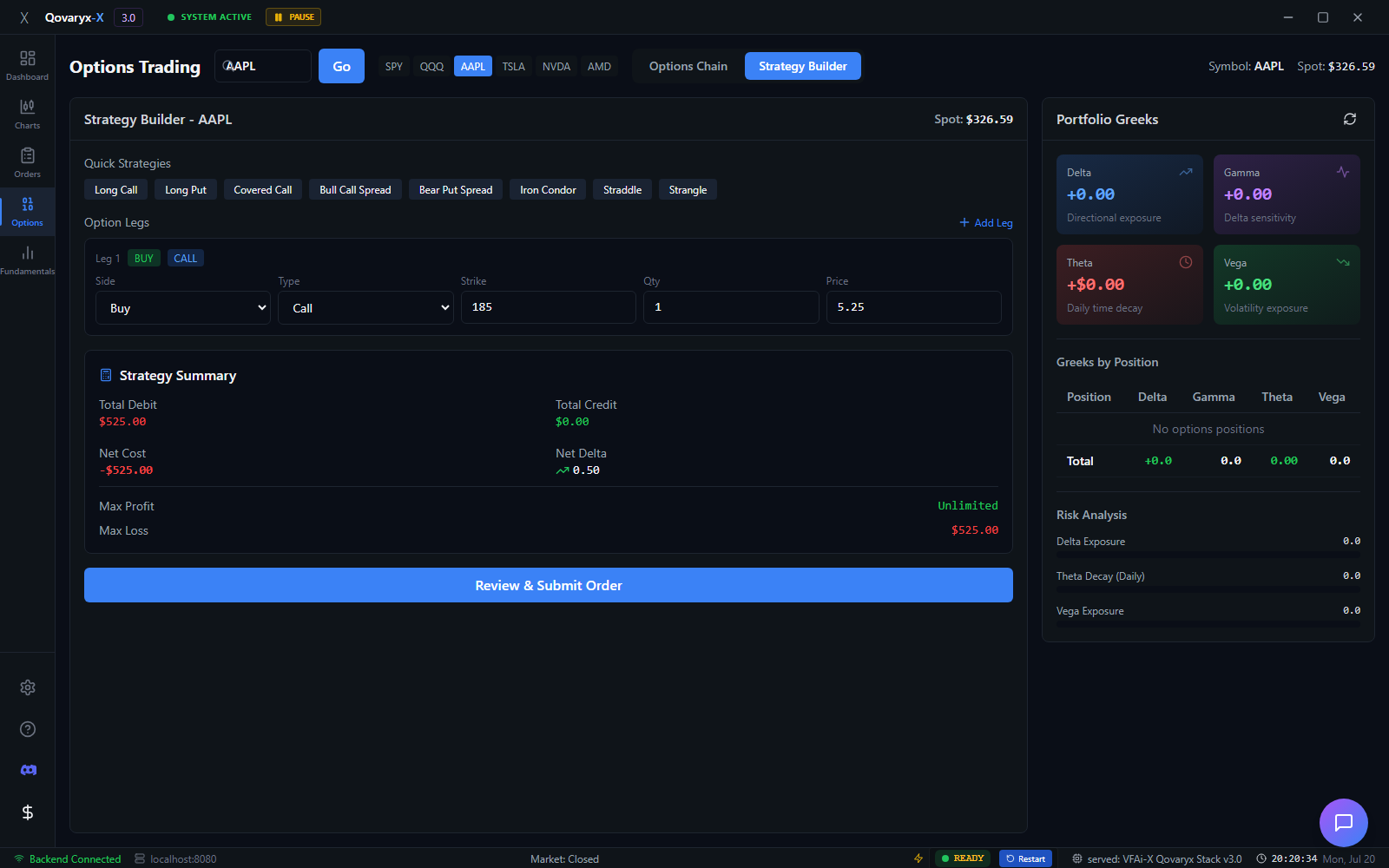
Detects when a single-leg option order is tagged with a multi-leg strategy name (iron condor, spread) and rejects with a clear error. Prevents accidental legging-in.
When a broker API fails or returns empty, the position panel falls back to the last successful snapshot (10-min TTL). No flickering to zero, no false-empty positions.
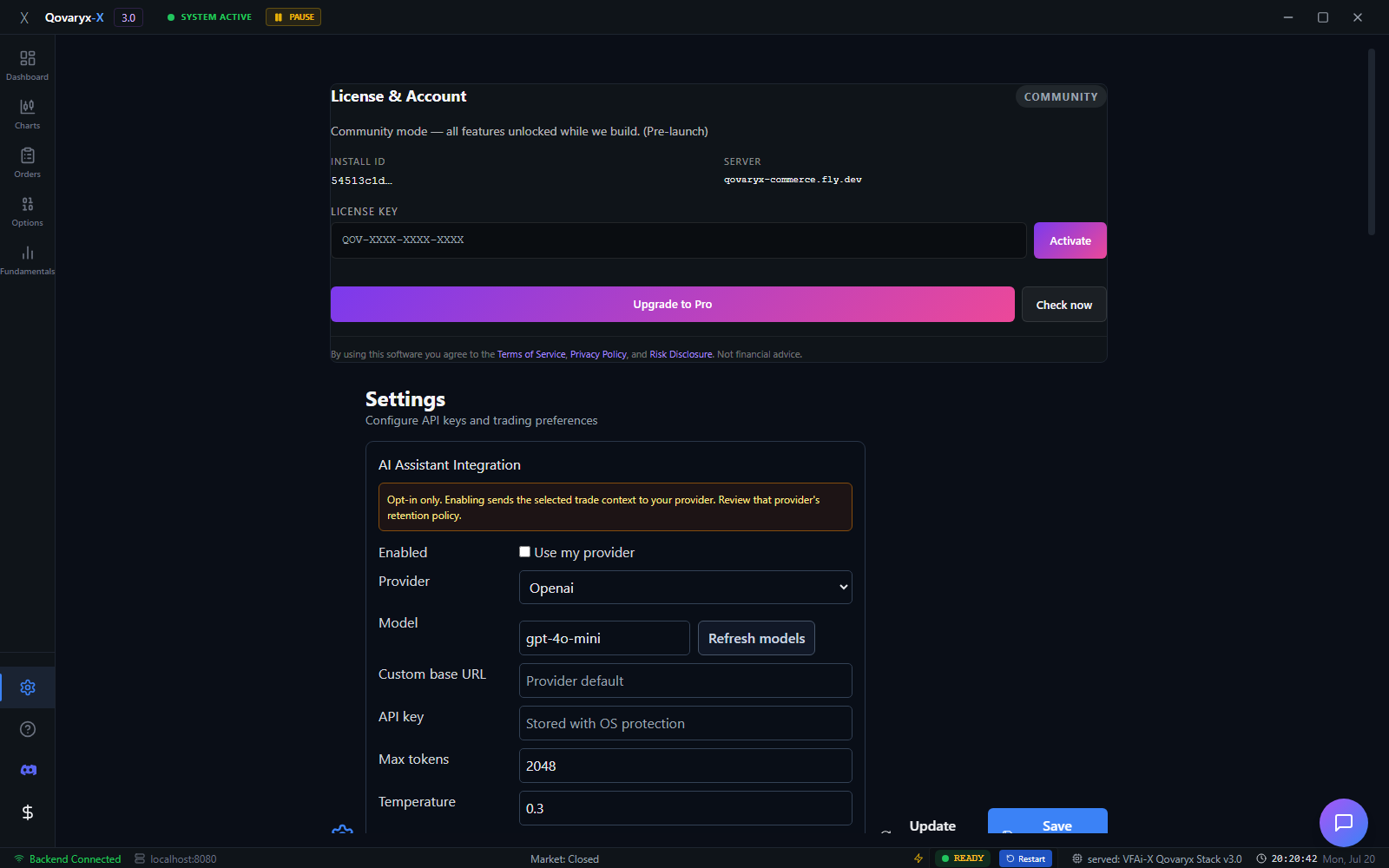
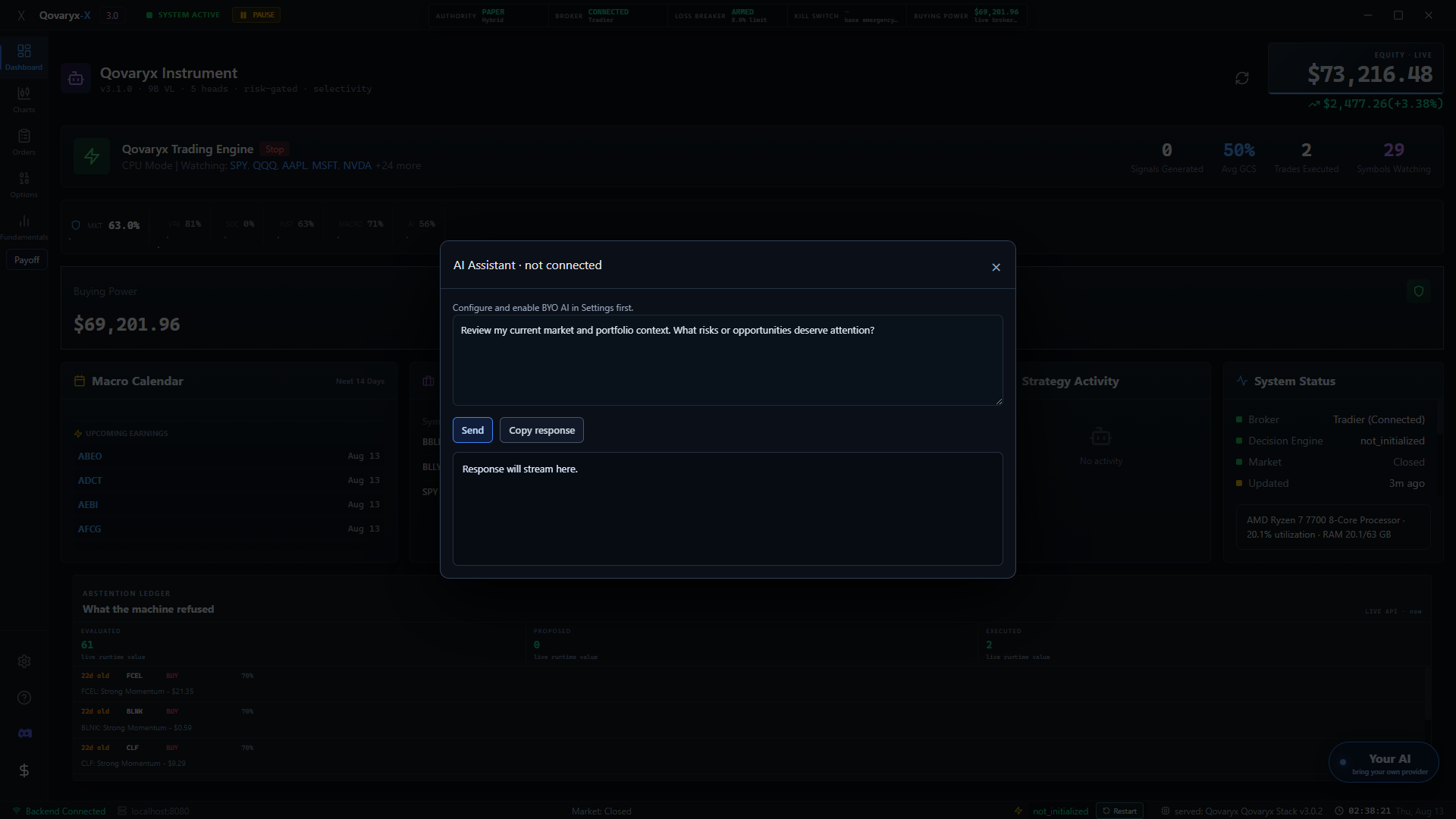
Connect any of 7 providers for chart analysis, position reviews, and market catalyst summaries: OpenAI, Anthropic, Google Gemini, xAI (Grok), OpenRouter, Ollama (fully local), and any custom OpenAI-compatible endpoint. Swap providers as models improve — no lock-in.
BYO-AI provider secrets use the app's per-user protected store (Windows DPAPI on Windows). They are sent only to the provider you select when you submit a chat request, never to JE Horizon.
You choose exactly which trading data the AI can see: positions, decisions, VPA signals, regime, portfolio equity, news catalysts, custom template. Off by default — you opt in per query type.
Attach PNG / JPEG / WebP / GIF charts up to 5 MB each (max 4 per message, 15 MB total). Kept in memory only — never persisted, only cryptographic hashes appear in the audit log.
Real streaming as tokens arrive. Default rate limit 30 requests/hour to prevent runaway usage on your own provider bill.
BYO-AI is a decision-support surface, not an execution surface. Order dispatch stays with verified specialist heads under strict authority contracts — see the note above about why LLM-agent trading is not consistently profitable.
Tradier, Alpaca, Charles Schwab, Robinhood, Tastytrade, TradeStation, and Interactive Brokers. The app reports each adapter's actual stocks, options, multi-leg, and paper/simulator capabilities before dispatch.
Full order_class:"mleg" support, separate paper/live keypairs, IEX quotes (free tier), auto-discovered options expirations.
Session-token auth with 24h expiry, remember-token refresh, auto-discovered account_id, native 1-4 leg multi-leg with price-effect field.
Targets the local IBKR gateway API at https://localhost:5000/v1/api, handles broker confirmation replies, and detects paper accounts by their DU prefix.
Quotes, charts, positions, and signal decisions are computed on your machine. License and update checks use install/version metadata only. Never trades, broker keys, or P&L.
License tokens are cryptographically signed by the server. Client refuses unsigned tokens in trial/paid modes. Prevents local license_token.json tampering.
Cached license tokens stay valid 14 days even if the network is unreachable. Day-trade on a plane, day-trade in a cabin. The model still runs.
If a beta build needs to be retired, the server can set tier=nuked in the signed envelope. App refuses to start the engine and shows a custom nuke-message. Leaks become traceable, revocable, dead-on-arrival.
The cluster tracks which internal path is hitting feature-coverage gates. Helps debug sparse callers without touching trade payloads.
Every result includes a build-ID stamp so leaked or misused outputs trace back to the exact binary that generated them.
Architecture notes cover local inference, calibrated context, abstention, evaluation discipline, and model governance without publishing execution recipes or thresholds.
We publish selected failure modes and methodology changes, not just launch notes. Selected artifacts and model cards are available through the Qovaryx Hugging Face organization.
Core evaluation runs on the local CPU without a GPU, Docker, or a separate Python installation. Broker and data operations still use their configured network services.
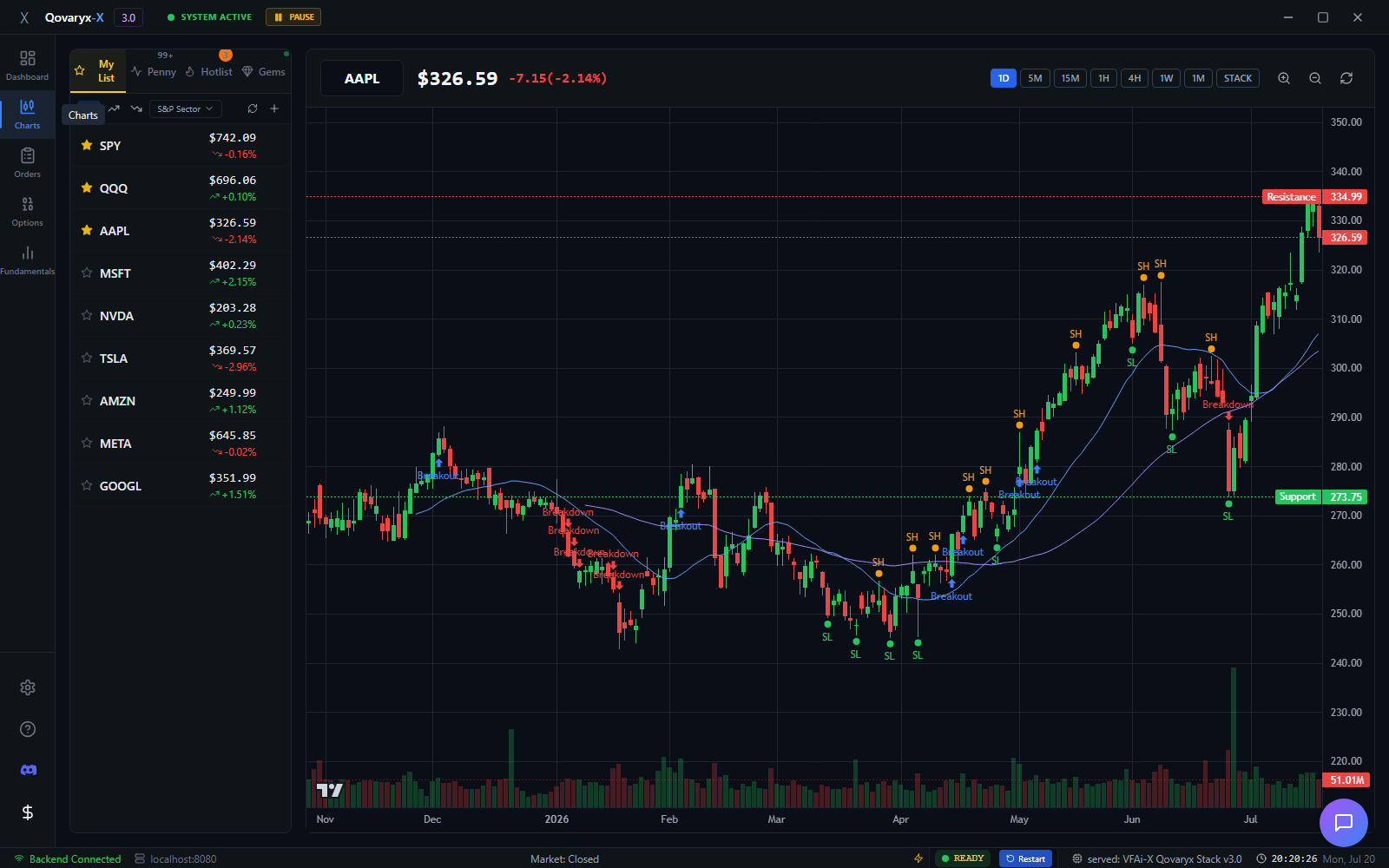
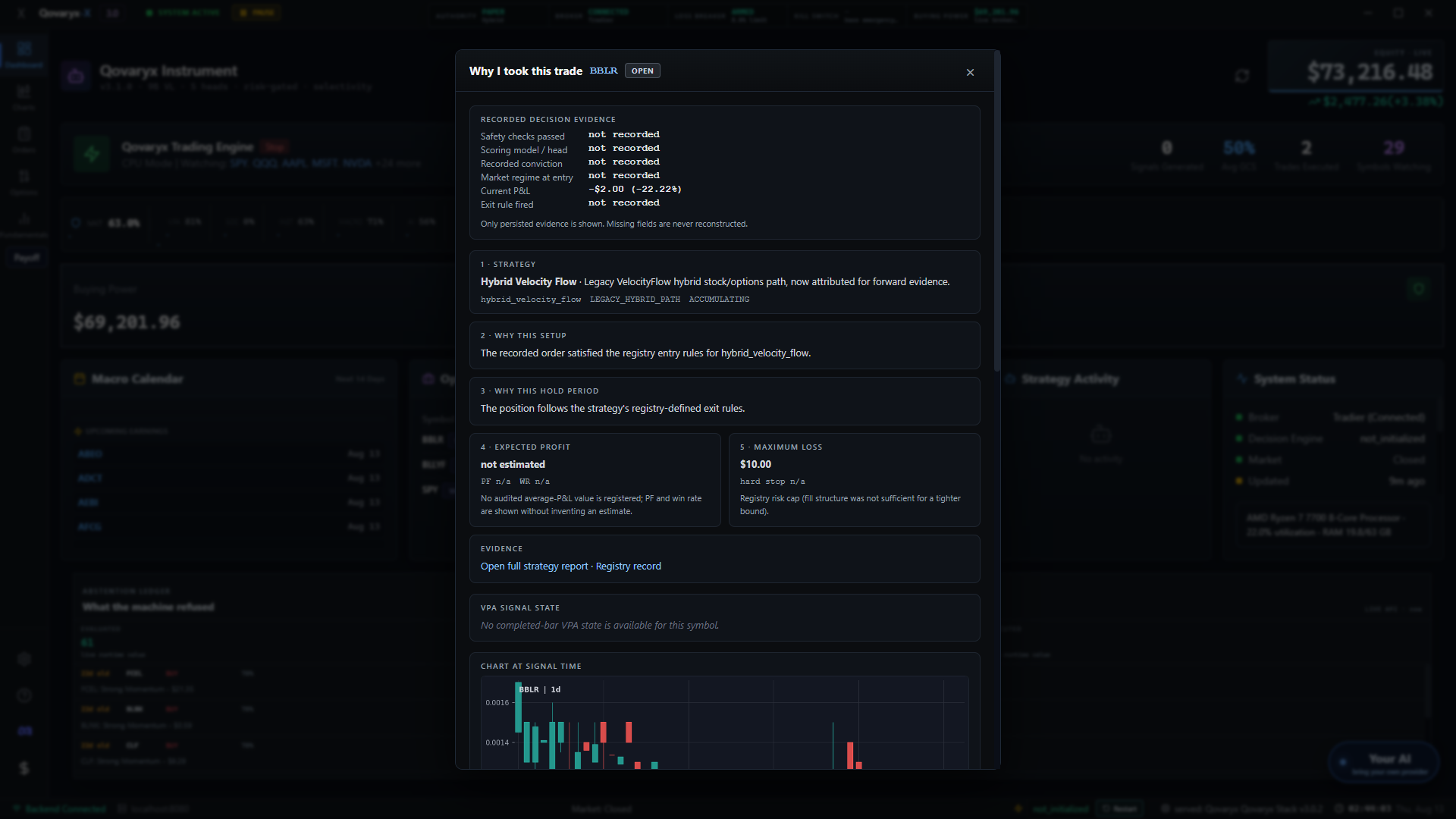
Eligible signals include the observed setup, applicable gates, strategy context, and a concise rationale. The Why view exposes VPA and regime context without presenting a model score as certainty.
Surfaces AI-identified high-conviction symbols (conviction ≥75%, feature coverage ≥40%) with one-click chart or trade. Edge-flip + fundamental gate + earnings blackout applied.
A single ribbon of broker radio buttons at the top of Settings. Pick one, the others collapse, the choice persists. No mile-long broker form.
Real-time CPU name, utilization, RAM usage, and cluster readiness make it clear whether the local engine and bundled specialist models are available.
A real-time market clock on the bottom bar labels the current session — open / premarket / afterhours / closed — in the correct color so you never click trade by mistake at 3am.
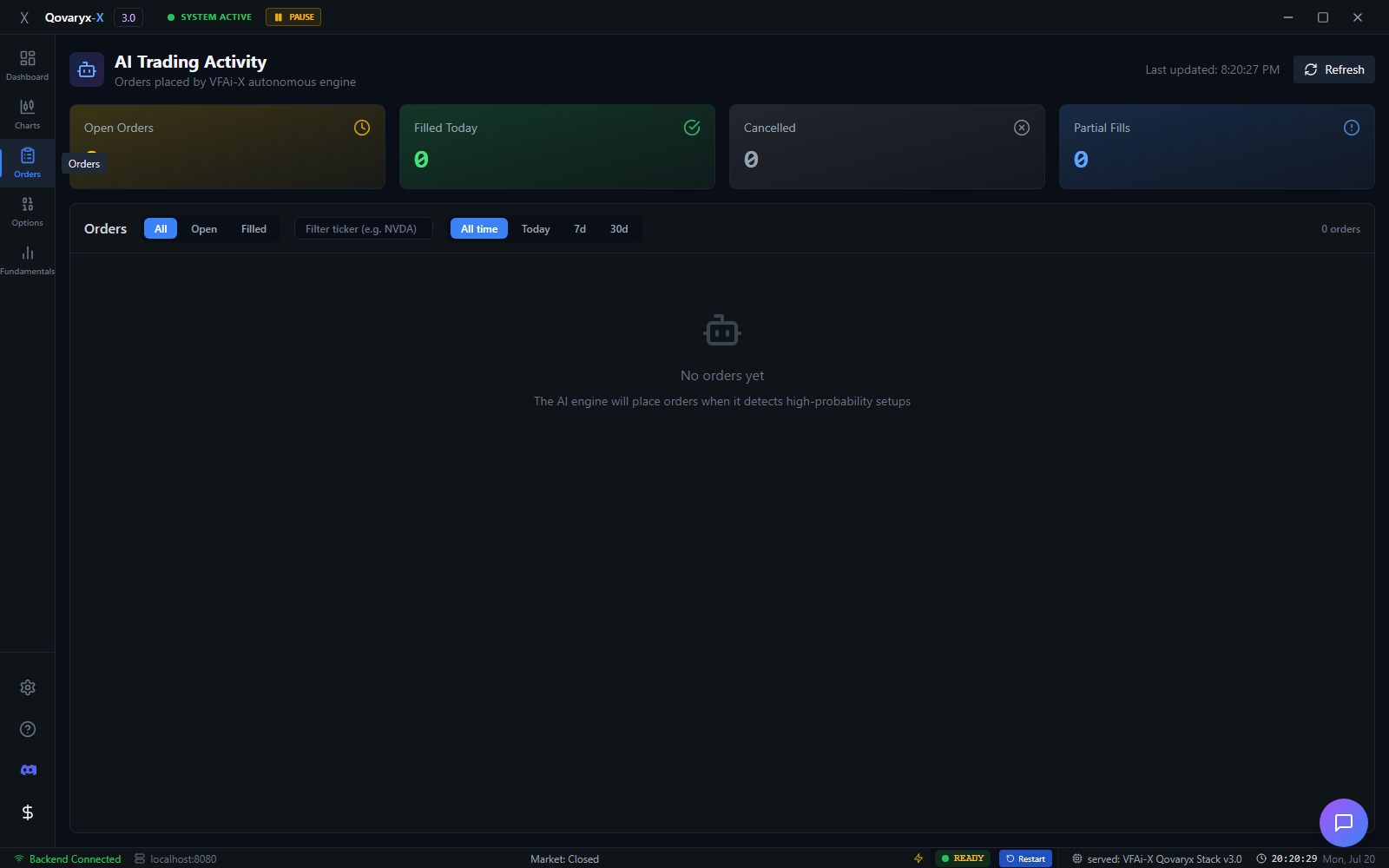
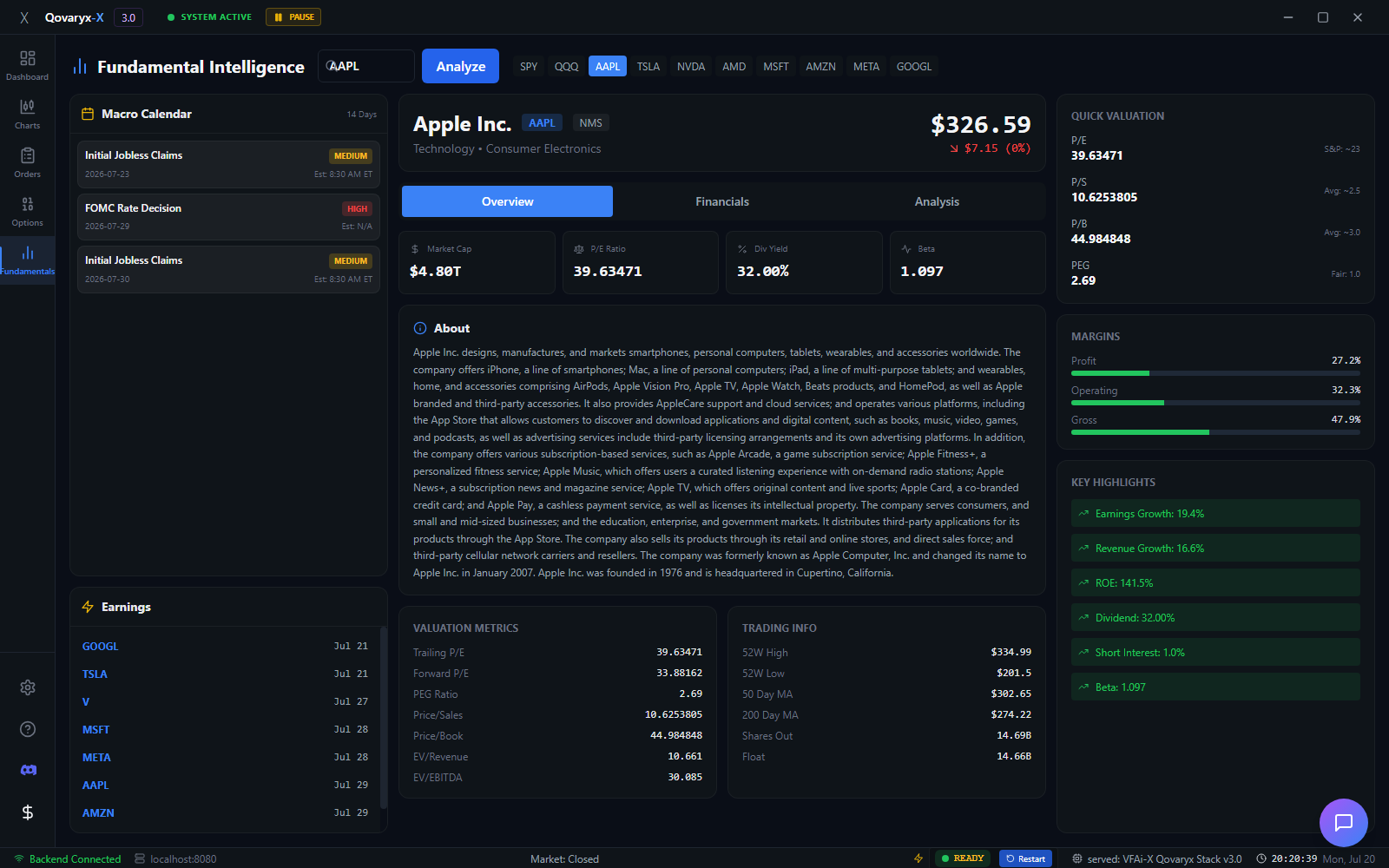
Unretouched application captures from the packaged Windows build in a clean first-run state. Open any image at full resolution.
Every other "AI trading" tool sends your decisions through someone else's servers. Honest, sourced, head-to-head. Pricing & features verified June 2026.
| Capability | Qovaryx | Trade Ideas | TrendSpider | Composer | Tickeron | Thinkorswim | Robinhood Legend |
|---|---|---|---|---|---|---|---|
| Runs on YOUR machine (CPU-local inference) | YES | Cloud + thin client | Cloud (web) | Cloud only | Cloud | Desktop UI, no AI | Cloud (Cortex) |
| Why it matters: when the model runs on your CPU, your watchlist, position size and order intent never become someone else's training data. Every cloud competitor logs at minimum metadata of every signal you've ever generated. | |||||||
| Trade data stays local | YES | No | No | No | No | No | No |
| Why it matters: the signals you click are a leading indicator of your real orders. Vendors who see them can sell aggregated order-intent to market makers, train future models on your trading style, or be subpoenaed. Local-only inference removes the entire pipe. | |||||||
| Works offline (signal computed without internet) | YES (broker feed still needed) | No | No | No | No | No | No |
| Why it matters: when the vendor goes down (Trade Ideas, TrendSpider, Robinhood have all had multi-hour outages in the last 24 months) the AI evaporates. Qovaryx still computes — only the broker feed is external. | |||||||
| Sovereign model — own weights, not a rented API | YES (bounded local specialists) | Proprietary cloud algos | RF/KNN cloud lab + Sidekick LLM | LLM-assisted editor | Proprietary "FLM" | None | Cortex (3rd-party LLM) |
| Why it matters: rented LLM APIs update silently, change refusal behavior, and price-hike with two weeks notice. A sovereign cluster is frozen weights on your disk — the model that was audited is the model that trades. | |||||||
| Broker integrations | 7 native | 3 (IB, E*TRADE, TradeStation) | 30+ via SignalStack relay | 1 (Alpaca/Apex only) | 0 retail; 2 institutional API | 1 (Schwab only) | 1 (Robinhood only) |
| Why it matters: 7 first-party adapters mean orders route direct — no third-party relay, no per-order surcharge, no broker lock-in. TrendSpider's 30+ routes through SignalStack with a 5-trade/mo free cap. | |||||||
| Local signal evaluation (no model-provider round-trip) | YES | No | No | No | No | N/A (no AI) | No |
| Why it matters: local CPU evaluation removes a hosted-model request from the decision path. End-to-end timing still depends on the selected broker, market-data source, and machine. | |||||||
| Calibrated conviction + deterministic NO_TRADE veto | YES (verifier-gated) | No | No | No | No | No | No |
| Why it matters: every other tool will always give you "an answer." Qovaryx's verifier head can force NO_TRADE when the specialists disagree or the conviction is uncalibrated — a hard-coded refusal layer no LLM-based competitor has. | |||||||
| Options-specific specialist heads (vol, regime, pattern, earnings) | YES (specialist cluster + production book) | Holly + Money Machine (equity bias) | Options Trader add-on | Symbolic ETF rotation | Single-strategy "robots" | Manual tools only | Generalist Cortex |
| Why it matters: a generalist LLM cannot reason about IV crush, gamma exposure, and regime shifts simultaneously. A cluster of small specialists each trained for one job composes a decision a 70B chat model cannot. | |||||||
| Monthly price | $29.99 | $127 – $254 | $33 – $88 | $40 (promo $5) | $20 – $90/robot | Free w/ Schwab | Free (Gold $5) |
| Why it matters: cloud vendors pay GPU bills every month — that's what you're funding above $80/mo. Local inference shifts compute to hardware you already own, which is why we can sit at $29.99 sustainably. | |||||||
| 30-day free trial | YES | 7-day $7 | 7-day | 14-day | 14-day | Free | Free |
| Why it matters: a real trial means at least one full options expiration cycle. 7-14 day trials don't even cover an earnings cycle or a Fed meeting. | |||||||
| Open research / public devlog | YES (28 articles, HF model cards) | Closed | Closed | Closed | Closed | Closed | Closed |
| Why it matters: every Qovaryx specialist ships with a public model card, the architecture decisions are in /research, and failure cases are written up honestly. No competitor lets you read why their model thinks what it thinks. | |||||||
| Watermarked builds + nuke-switch + signed license | YES (Ed25519) | No | No | No | No | No | No |
| Why it matters: because the model lives on your disk, leak prevention has to live on your disk too. Every build is per-user watermarked, every license is Ed25519-signed, and a revoked key can disable a stolen copy in < 1 hour. | |||||||
Sources: trade-ideas.com · trendspider.com · composer.trade · tickeron.com · schwab.com/thinkorswim · robinhood.com/legend. We mark "YES" only where Qovaryx genuinely ships the capability today. Pricing & features verified June 2026; subject to change.
~7,200 US stocks + ~1,340 ETFs, daily OHLCV going back four and a half decades. Enough coverage to grade every strategy across every regime that has actually happened — not just the last five bull years.
Multi-year full-chain history for a targeted set of highly liquid names: SPY, QQQ, AAPL, NVDA, TSLA, and more. Contract-level bid/ask/sizes, IV, all Greeks, open interest — the kind of data that is normally paywalled at $300+ per symbol-year.
Candidates are graded through the strategy consumer that would use them, including execution costs and contract-selection behavior where the corpus supports it. Synthetic labels remain explicitly marked and cannot silently become real-data authority.
Where real chain data doesn't exist, we generate synthetic prices with a properly calibrated model — and then run label-bridging validation to confirm the synthetic distribution matches real where they overlap.
Every new head hypothesis passes through a four-stage funnel: cheap CPU screen, paired-lift test against the current best, consumer-space five-year replay, and regime-conditioned stress. 30+ hypotheses ran through the funnel between beta and 3.0. Most die. The survivors are what ship.
Failed heads are analyzed by failure mode, rebuilt only when there is a specific corrective hypothesis, and then sent through the full funnel again. A prior model's status never carries over to its replacement.
Deeper dives: Head architecture advances · The data moat. Framings are public; recipes are not.
Join the Qovaryx 3.0 launch list to run the local strategy engine, scoped specialist cluster, and optional BYO-AI chat on your own machine.
Request launch access → Join Waitlist